Dydxswap funding rates determine who pays on dYdX Chain perpetual positions
Dydxswap funding rates determine whether long or short perpetual positions pay funding on dYdX Chain. Positive rates make longs pay shorts; negative rates reverse that direction. The default v4 schedule applies funding hourly, and those payments change realized profit and loss while a position remains open.
A funding percentage needs its time window and position side before it can explain an account's payment.
1. Who pays when the funding rate changes sign?
Positive funding makes long positions pay short positions, while negative funding makes shorts pay longs. The cash amount also depends on position size and the tick's oracle price.
| Position side | Funding cash flow | Required applied rate |
|---|---|---|
| Long | Pays shorts | Positive |
| Short | Receives from longs | Positive |
| Long | Receives from shorts | Negative |
| Short | Pays longs | Negative |
| Either side | No new funding for that tick | Zero |
An earlier positive or negative quote doesn't fix the sign of later funding periods. The rate that actually applies to each event determines its payment direction.
2. Match the displayed rate to its time window
The Funding tab in the documented v4 front end offers one-hour, eight-hour, and annualized views for the selected market. Certain products or services may be unavailable under the provider's terms to people or entities that reside in, are located in, are incorporated in, or have registered offices in the United States, Canada, or another restricted jurisdiction. Each percentage needs its stated period before it can support a holding-cost comparison. An eight-hour view doesn't change the default hourly funding schedule. An annualized number expresses a rate on a yearly basis; it doesn't establish payments throughout that horizon. Later periods can have different premiums, and a position can change size or close before them. Comparisons also need the same basis: funding amounts follow position value, not just deposited margin.
Extending one hourly rate across several hours assumes unchanged rates. Applying that projection to an account also assumes unchanged exposure and valuation inputs. A historical applied rate describes a completed funding period, whereas a forward estimate can change before application. Neither one alone describes the position's entire holding cost.
3. How do order-book prices become a funding rate?
The protocol derives a premium from order-book execution prices relative to the market's index price. The impact bid is the average execution price for a market sell of the impact notional. The impact ask is the corresponding average for a market buy. These inputs reflect available depth beyond the best displayed price. Funding creates incentives for the perpetual price to move toward the oracle price.
The premium formula is
Premium = (max(0, impact bid - index price) - max(0, index price - impact ask)) / index price
. The two nonnegative terms measure bid-side premiums and ask-side discounts. Their difference determines the premium's sign. A last trade alone doesn't supply the required impact-price inputs.
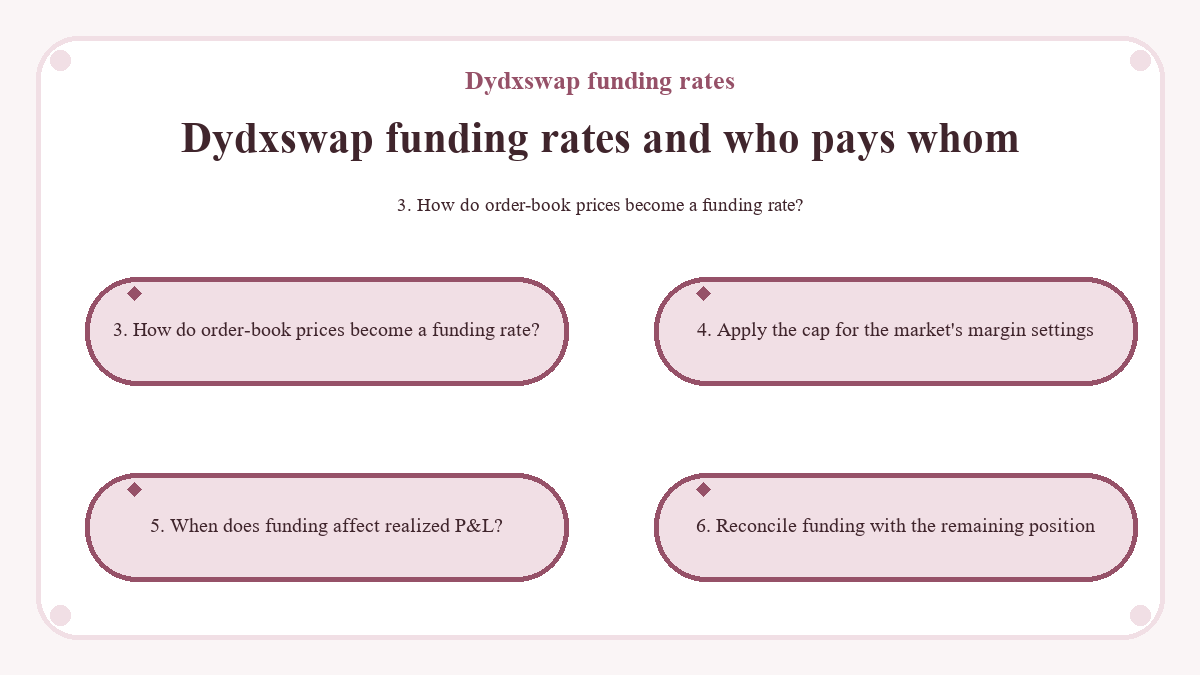
Dydxswap funding rates and who pays whom
- 3. How do order-book prices become a funding rate?
- 4. Apply the cap for the market's margin settings
- 5. When does funding affect realized P&L?
- 6. Reconcile funding with the remaining position
The documented v4 relationship for impact notional is
500 USDC / initial margin fraction
, with the fraction expressed as a decimal. The applicable liquidity-tier setting supplies the calculation size. This amount defines how much order-book depth the premium calculation considers; it isn't the trader's requested order amount or funding payment.
Block proposers submit premium votes from their local order books. Under the v4 defaults, the protocol combines votes into one-minute samples, then aggregates samples over the funding interval. The hourly formula divides the premium component by eight and adds the market's hourly interest component. Cross and isolated markets can carry different interest components. A nonzero interest component can offset the premium and change the final sign. The resulting rate then passes through the applicable cap before it changes funding accounting.
4. Apply the cap for the market's margin settings
In the v4 defaults described on April 23, 2026, the absolute eight-hour funding-rate cap equals 600% times the difference between initial and maintenance margin fractions. Both margin inputs are fractions of position value. A larger gap produces a wider rate bound when the clamp factor stays unchanged. The cap constrains the percentage, while position size still determines the resulting cash amount. It doesn't bound losses from a market-price move.
The protocol also caps premium samples. Governance can change clamp factors and epoch durations, so the applicable ceiling needs its time basis. With the default one-hour tick, the hourly rate cap is one-eighth of the eight-hour ceiling.
5. When does funding affect realized P&L?
Funding affects realized profit and loss while a position remains open under the applicable funding schedule. The v4 default configuration uses an hourly funding tick. A tick with a nonzero rate updates the market's cumulative funding index, which tracks accumulated funding per unit of position size. A position's funding follows the difference between that index and the index already recorded for it. Subaccount updates settle that accumulated difference before applying position or collateral changes. The market tick and an update to the stored account balance are therefore distinct accounting events.
For one default hourly tick, the cash-flow relationship before protocol rounding is
C = -S * P * R
. Here,
S
is signed position size: positive for a long and negative for a short.
P
is the tick's oracle price, and
R
is its applied hourly rate expressed as a decimal. A positive
C
means a receipt; a negative value means a payment. With size in base-asset units and price in quote units per base unit,
C
is a quote-currency amount.
Across multiple ticks, rates and oracle prices can change. Position changes also alter the calculation, so one final rate and one final position size can't reconstruct every earlier payment.
6. Reconcile funding with the remaining position
Portfolio history records funding payments, while the positions panel shows exposure that remains open. History identifies amounts already paid or received for the account. A market's historical funding series describes rates; account payment history describes the account's exposure to those rates. Reconciliation needs the same market, account, and period, especially when fills changed position size. A current quote can't replace those historical entries. Accrued funding from earlier exposure still belongs in the account's history after a later exit.
Market and limit orders change exposure through execution. The requested amount doesn't establish the filled amount, and an open exit order doesn't establish a closed position. Execution records explain size changes that affect later funding. A partial exit leaves the unclosed position exposed to subsequent funding ticks.
Things people ask about Dydxswap funding rates
Does a Post-Only order avoid funding charges on dYdX Chain?
Post-Only controls maker execution and doesn't exempt a resulting position from funding. The order either rests on the book or cancels if it would immediately match. An executed order can create or change exposure that pays or receives funding under the market's applied rate.
Does leverage change Dydxswap funding rates?
Leverage doesn't directly set the market's funding rate. The calculation uses the market's premium and configured interest component. For the same funding period, position size, oracle price, and applied rate, changing deposited margin doesn't change the funding amount. Funding has a larger effect relative to a smaller margin deposit.
How can funding payments be retrieved for a particular subaccount?
The Get Funding Payments API method retrieves payment history for a wallet address and subaccount number. It supports a market filter and returns payment details such as amount, funding rate, position size, market, and timestamp. The separate parent-subaccount method aggregates payments across the child subaccounts of that parent.
What interest baseline applies to isolated-market funding in v4?
The documented v4 isolated-market default adds 0.125 basis points per hour, equivalent to 1 basis point per eight hours, as the interest component. The total rate also includes the premium-derived component. Market parameters can change through governance, so that baseline doesn't establish the live total funding rate.
Why does a positive amount in a v4 settled funding event represent a payment?
V4 settled funding events record paid funding as positive and received funding as negative. That payment convention differs from a signed account cash flow, where a receipt is positive. A positive market funding rate separately means that long positions pay short positions.
Can receiving funding make a losing perpetual position profitable?
Funding receipts can make the overall trade profitable if they exceed its price loss and other trading costs. A receipt by itself doesn't establish that outcome. Overall P&L includes the position's other gains and costs, and later funding can reverse direction when the applied rate changes.
Updated on